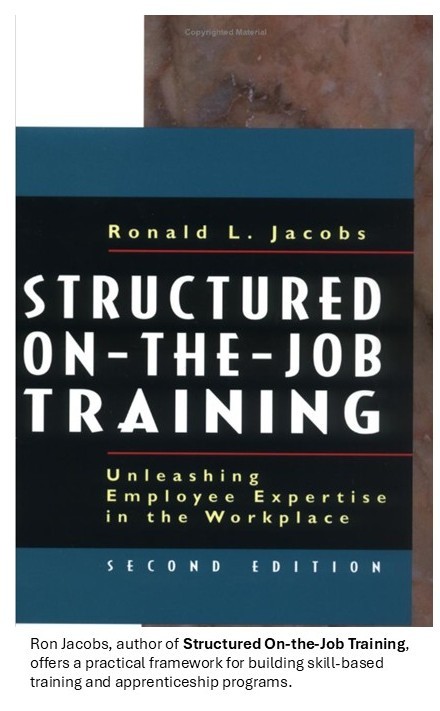
In this article, I wish to share some reflections when discovering an important and often overlooked apprenticeship program outcome: trainee and trainer confidence. Our upcoming MUS Learning Lab on January 20 will focus on understanding and implementing competency-based apprenticeships. We believe there is emerging interest in competency-based apprenticeships these days, in contrast to time-based apprenticeships, consistent with greater emphasis on program accountability. We’re hopeful the Learning Lab will help generate dialogue about the topic.
While it’s too early to report outcome data from the current project, we will share a wealth of results from over forty years of examining structured on-the-job training, a key aspect of competency-based apprenticeships. For the most part, my focus has been on evaluating S-OJT from the business perspective: calculating ROI ratios, reduced time to proficiency, reductions in error rates, and the like. In fact, if you’re interested in outcomes from that perspective, I refer you to my chapter in ATD’s Handbook for Measuring & Evaluating Training, 2nd Edition (2025), that describes a case study how S-OJT was used in a construction company to reduce errors in concrete work, leading to a reduction of rework cost.
However, of importance in this article are reflections about outcomes we discovered from the trainees’ perspective. A number of years ago, we did a relatively large project in Kuwait, developing an S-OJT program for new-hire petroleum engineers (Jacobs & Bu-Rahmah, 2012), which turned out much like an extended apprenticeship program. A refinery is a high-risk environment, in which making an error might lead to critical safety and health incidents. Following implementation, I was asked later on to gather some evaluation information for the organization. Knowing that designers shouldn’t evaluate their own efforts, I asked some colleagues to join in the process.
We interviewed trainers and trainees individually and in small groups and realized an emerging trend that we’d not ever considered. Objective measures showed that S-OJT had reduced training time by at least a year, which was anticipated. We also found some unanticipated outcomes that continue to make a lasting impression. That is, graduates from the program expressed a high degree of confidence about their ability to do the work. And independently, experienced engineers involved in the program expressed a high degree of confidence in the abilities of trainees. Of note, the program design included a number of experienced engineers who served as trainers, who delivered the S-OJT, and as checkers who evaluated trainees afterwards.
Confidence is an interesting and often transitory construct. Some people might express confidence through an unwarranted over estimation of their abilities. Others might downplay their confidence hoping to be viewed more humbly, even though they possess the abilities in question. When confidence is expressed from two independent sources, especially from experienced engineers who are typically cautious when assessing trainees in this work environment, we were compelled to report our belief that trainee and trainer confidence was well founded.
For apprenticeships today, trainee and trainer confidence remains a critical factor for success, even though it doesn’t seem to attract as much attention as it should. In fact, confidence likely relates with other outcomes, such as program retention and persistence. We surmise, with some confidence of our own, that confidence and achievement go hand in hand, and that’s the basis of my belief in the value of a competency-based apprenticeship approach. Nothing beats the feeling of satisfaction after having mastered something difficult, and a competency-based approach gives trainees a fair shot at doing so.
My colleague, Scott Bowes, and I look forward to sharing our experience and exchanging ideas at our upcoming MUS Learning Lab on January 20.
References
Jacobs, R.L., and Bu-Rahmah, M. (2012). Developing employee expertise through structured on-the-job training (S-OJT): An introduction to this training approach and the KNPC experience. Industrial and Commercial Training, 2.
Jacobs, R. L. (2025). Using Financial Analysis to Compare OJT and S-OJT. In Handbook for Measuring & Evaluating Training, 2nd, Patti Phillips (ed). Alexandria VA: Association for Talent Development.