In case you haven't been following the latest news coming out of OMB, On May 29, 2026, OMB proposed revisions to the Uniform Guidance and they could significantly reshape the administration of discretionary federal awards.
Largely, the traditional financial management looks to remain the same; however, the proposal places a much greater emphasis on federal oversight, recipient accountability, agency discretion, and alignment with federal policy priorities.
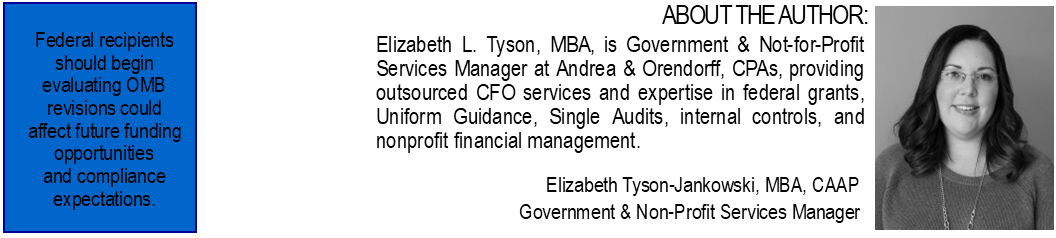
It’s important to note that these changes are still in the proposal stage and currently subject to public comment. Regardless, Federal recipients should begin evaluating how the revisions could affect future funding opportunities and compliance expectations.
Below is a brief listing of the highlights of the proposals.
Elimination of Fixed Amount Awards and Subawards
This change could have a significant impact on those organizations that are currently relying on milestone-based or fixed funding. These groups should anticipate a return to more traditional cost-reimbursement models with an increase in documentation requirements, including potential for:
- More detailed cost tracking and supporting documentation
- Increased monitoring of subrecipients
- Reduced flexibility in structuring subawards
Expanded Federal Agency Authority to Suspend or Terminate Awards
The proposal clarifies and increases federal agencies' authority to suspend or terminate discretionary awards. Agencies would retain broad discretion to terminate awards that are no longer aligned with agency priorities, are not achieving intended objectives, or are otherwise determined not to be in the federal government's interest.
Recipients should be aware that future funding decisions (even after funding has been awarded) and continued funding may depend not only on compliance performance but also on continued alignment with changes in federal priorities.
Increased Scrutiny During Pre-Award Risk Assessments
OMB proposes expanding the factors agencies may consider when evaluating applicant risk. In addition to financial stability and prior performance, agencies could be required to consider and evaluate:
- Organizational history of questionable practices
- Foreign affiliations and relationships
- Compliance with foreign gift disclosure requirements
- Publicly available information regarding organizational integrity
- Affiliations that could present national security concerns
Both prime applicants and subrecipients should anticipate more rigorous pre-award reviews and should ensure governance, compliance, and disclosure processes are well documented.
It is anticipated that subrecipients of discretionary awards may not simply be “written in” going forward. Prior to adding a subrecipient to any bid the pre-award risk assessments should be completed and documented as part of the application process.
Stronger Subrecipient Oversight and Reporting Expectations
The proposal places substantial emphasis on improving transparency surrounding subawards and pass-through entity responsibilities. OMB specifically identifies concerns regarding incomplete subaward reporting and proposes enhanced oversight expectations.
If you are a recipient issuing pass through funds to a subrecipient; you should review your practices around:
- Related-party and affiliate relationships
- Subrecipient monitoring
- SAM.gov reporting practices
- Documentation supporting subrecipient determinations
Additional Payment and Cash Management Controls
OMB proposes additional safeguards for payment requests and disbursement of federal funds. Federal agencies and pass-through entities may be expected to exercise greater due diligence before issuing payments, including enhanced justification for payment requests.
Recipients should prepare for:
- Increased review of reimbursement requests
- More detailed payment documentation requirements
- Potential delays in payment processing
Potential Changes to the Single Audit Framework
While the proposal does not eliminate Single Audits, it does signal potential changes to one of the most important components of the current audit process: the Compliance Supplement.
OMB proposes removing the requirement for annual issuance of the Compliance Supplement and indicates it is reevaluating both the frequency and future structure of Compliance Supplement updates. For many recipients and auditors, the Compliance Supplement serves as the primary resource for identifying applicable compliance requirements and audit procedures.
If finalized, recipients may need to place greater reliance on:
- Award terms and conditions
- Agency regulations and guidance
- Program-specific requirements
- Special award conditions
Organizations should monitor this area closely, as any changes could have significant implications for future Single Audit planning and compliance efforts.
Increased Focus on Cost Effectiveness and Administrative Costs
Although the proposal does not establish a government-wide cap on indirect costs, OMB repeatedly emphasizes stewardship of taxpayer dollars and concerns regarding excessive administrative and overhead expenditures.
Organizations with higher indirect cost rates are not automatically disqualified from receiving federal awards. However, federal agencies may place greater emphasis on:
- Cost effectiveness
- Budget reasonableness
- Administrative cost structures
- Demonstrated program outcomes
- The proportion of funding reaching program beneficiaries
Recipients should be prepared to clearly explain how indirect and administrative costs support program objectives and provide value to the federal government.
Changes in Cost Allowability
From a cost allowability perspective, the proposed rule is actually much less dramatic than media headlines about DEI, termination authority, and oversight might lead one to believe.
However, there are several proposed changes that could have real implications for questioned costs, allowability determinations, and future Single Audit findings; primarily an increased focus on "Authorized Public Purpose”
Under this proposal, auditors and federal agencies may place greater emphasis on: "Does this activity directly support the statutory purpose of the award?"
Costs that are only loosely related to the grant's objectives may face greater scrutiny.
If finalized, costs associated with activities prohibited by those sections could become unallowable.
Certain DEI initiatives that agencies determine violate federal anti-discrimination laws include:
- Certain gender ideology programs
- Certain foreign collaborations
- Activities inconsistent with agency-imposed award conditions
What these changes do NOT do is create new unallowable cost categories in Subpart E. Instead, they create new prohibited activities and policy restrictions. Costs associated with those prohibited activities would become unallowable when charged to federal awards.
For CFOs, grant managers, and auditors, the compliance question may increasingly become: "Does this activity comply with the new programmatic restrictions and federal policy requirements? Does it meet the tests of both necessity (i.e.. necessary to meet the end objectives of the program) and reasonableness?
Final Thoughts
While many of the headlines surrounding the proposed Uniform Guidance revisions focus on policy changes, the broader theme running throughout the proposal is increased accountability for the use of federal funds.
Over the past several years, recipients have seen a number of requirements relaxed or streamlined in an effort to reduce administrative burden and improve access to federal funding. This proposal appears to signal a shift in the opposite direction, with greater emphasis on oversight, documentation, risk assessment, transparency, and stewardship of taxpayer dollars.
Are grant recipients under attack? We certainly hope not.
The overwhelming majority of federal award recipients work diligently every day to serve their communities, fulfill program objectives, and responsibly manage public funds. However, highly publicized instances of fraud, waste, abuse, and improper payments have increased public and governmental scrutiny of federal spending.
Ultimately, maintaining public trust in federal programs is a shared responsibility. Strong internal controls, thoughtful procurement practices, effective subrecipient monitoring, and sound financial management not only protect organizations from audit findings, they help ensure that federal funds achieve their intended purpose and that the actions of a few do not undermine confidence in the many organizations doing great works correctly.
As the proposal moves through the rulemaking process, recipients should stay informed, evaluate the potential impact on their organizations, and continue focusing on the fundamentals of good grants management and responsible stewardship.