Access to child care enables parents to work and pursue further education and training, making early childhood education (ECE) providers the workforce behind the workforce. Child care availability depends on the supply of qualified early educators. Limited ECE classrooms force many parents, particularly women, to reduce their hours, turn down job opportunities, or leave the workforce altogether. This creates a self-perpetuating cycle: a lack of ECE professionals leads to fewer child care options, which in turn shrinks the available labor pool. Child care is labor-intensive and requires highly skilled early childhood educators to address the safety, health, and optimal development of children in care. This creates a longstanding challenge in the recruitment and retention of providers in the ECE industry: low wages and a lack of benefits.
When you picture a job in ECE, do you picture teachers in a classroom with small children? Teaching is one of many opportunities for anyone interested in educating and caring for our youngest learners. When my colleagues and I talk about the variety of ECE careers with employers, workforce boards, and even ECE center directors, several questions keep popping up:
Can workforce development programs like Registered Apprenticeship be adapted for an industry like ECE?
· What could a fulfilling career in ECE look like?
· Is there a productive pathway to higher-paying occupations with benefits?
· The Early Childhood Workforce Connector and ECE RA Programs
The Early Childhood Workforce Connector (ECWC) is dedicated to advancing a highly qualified and well-compensated early childhood education (ECE) workforce through supporting the development and expansion of Registered Apprenticeship (RA), Youth Apprenticeship, and pre-apprenticeship programs. We recognize that apprenticeship programs are a vital investment in the early childhood workforce, and we have adapted this proven model to address critical challenges in the child care sector, supporting the development of high-quality and supportive child care services. By integrating professional learning, mentorship, and professional compensation, ECE RA programs uplift educators, the local workforce, and the communities they serve. Critically, ECE apprenticeship programs provide clear pathways to sustainable ECE careers and professional compensation.
ECE jobs must be recognized as sustainable careers, rather than merely stepping stones to better-paying positions in public education or other sectors. Recruiting or upskilling workers and then retaining them is crucial to the continuity of relationships, which is a key component of high-quality ECE. RA programs in ECE can be designed to offer multiple entry points, jumpstarting careers, facilitating professional development, and creating pathways to career advancement, credentials, and academic degrees. They can work with the numerous progression routes that exist in ECE, from entry-level to advanced roles. ECE benefits from stackable RA models that create clear, employment-first career pathways from entry-level roles like teacher assistant to leadership positions like ECE program director. RA programs also expand capacity in understaffed roles, such as Family Child Care (FCC) providers and home visitors, offering multiple entry points for aspiring professionals.
Careers in ECE
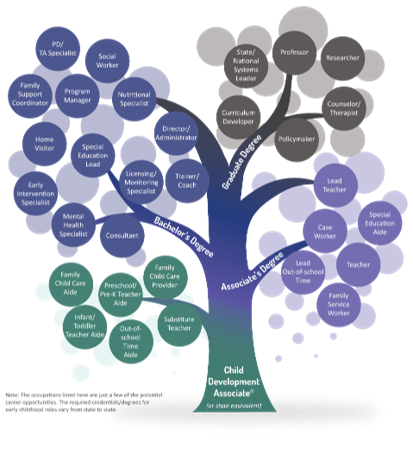
To visually represent the diverse career opportunities in ECE, ECWC created an infographic (see below) that showcases numerous occupations, specialties, and career pathways within the field. One can start with an entry-level position, such as a substitute teacher, and through education and experience, progress to more sustainable roles like a curriculum developer. Along the way, apprentices can obtain credentials such as the Child Development Associate (CDA), certificates, and degrees. This demonstrates that whether someone is an experienced professional or just starting, there is an RA program suitable for many stages of a career pathway in ECE.
This resource is an innovation that helps our partners recruit and retain a diverse workforce that is aware of opportunities for promotion or advancement within the industry and the broader field of ECE.