When I experienced being laid off after more than two decades in the private sector, I did not immediately enter the public workforce system.
Instead, I became an entrepreneur. For more than two years, I worked to build and sustain my own small business. That experience taught me a great deal about resilience, risk, and the realities of creating economic opportunity for yourself. But eventually, the business was not generating enough income, and I had to begin looking for employment again.
I updated my résumé, submitted applications, and tried to make sense of how my years of private-sector leadership and entrepreneurial experience fit into a changing labor market.
What ultimately changed my trajectory was not another online application. It was a conversation. A career coach at my local workforce development organization took the time to understand the full arc of my experience—not only my previous career, but also what I had learned through entrepreneurship, the challenges I had faced, and the value I could bring to a new opportunity. She helped me recognize transferable skills, reconsider how I positioned myself, and see possibilities I had not been able to see alone.
Years later, after joining the public workforce system myself, I understood that she was the human face of something much larger: an entire ecosystem working behind the scenes to connect people, resources, and opportunity. She was the visible face of an invisible ecosystem.
Looking Beyond the Job Fair
Ask most people what comes to mind when they hear workforce development, and the answers are often predictable: job fairs, résumé workshops, interview coaching, or unemployment assistance.
Those services matter. But they tell only a small part of the story.
Behind every successful career transition lies a complex ecosystem of organizations working together—often quietly and largely unnoticed—to help individuals, businesses, and communities thrive.
The public workforce system is far more than a collection of programs.
- It is a regional convener.
- A trusted connector.
- An ecosystem builder.
Its work is not defined by a single service, but by its ability to align education, industry, government, and community around one shared purpose: expanding opportunity. Workforce Development is the Swiss Army knife for economic prosperity, mobility and impact.
Connecting the Dots
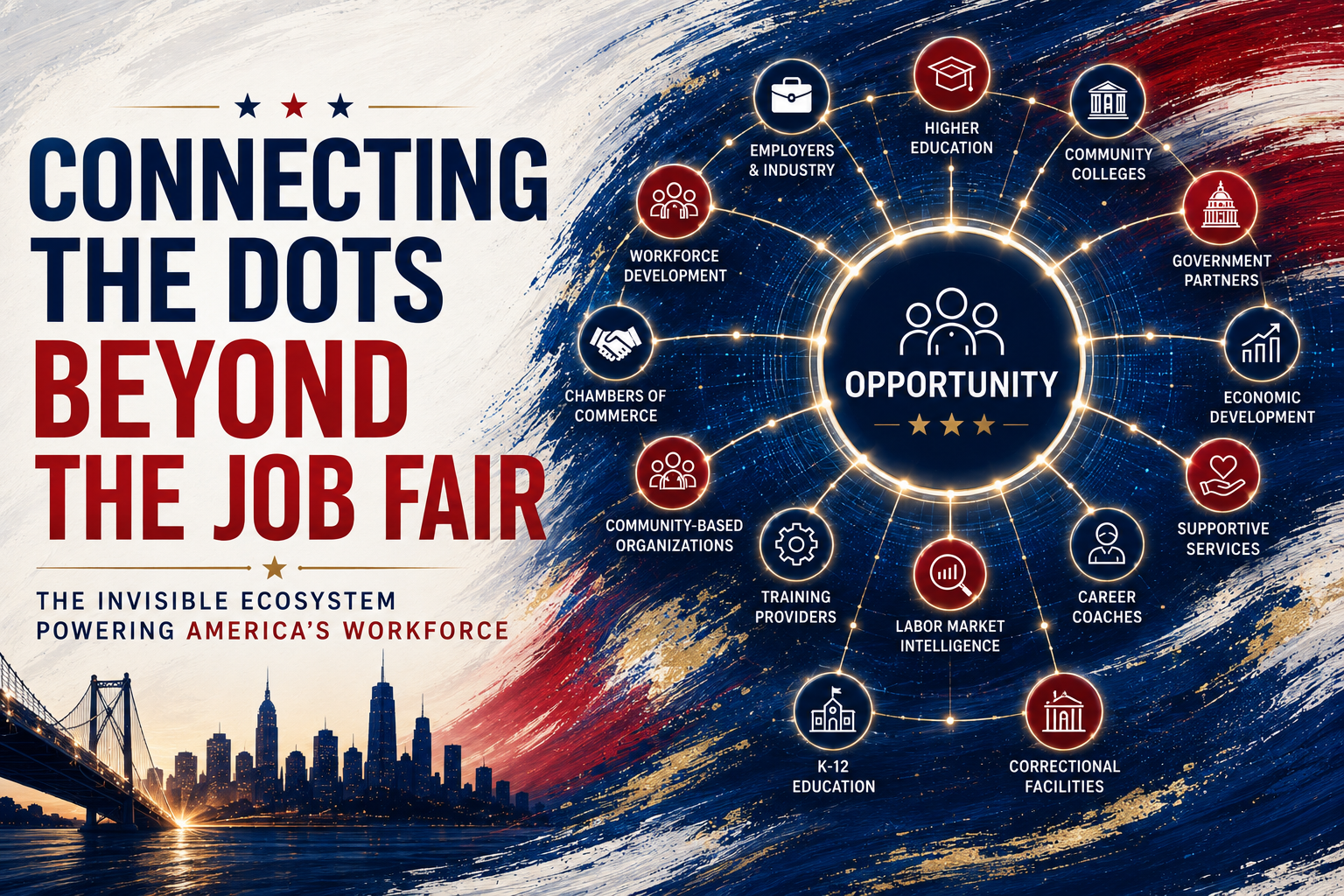
Today's workforce challenges cannot be solved by any single organization.
- Employers understand evolving talent needs.
- Community colleges and universities develop education and credential pathways.
- K–12 systems prepare tomorrow's workforce.
- Training providers deliver occupational skills.
- Chambers of Commerce strengthen business engagement.
- Economic development organizations attract and retain industry.
- Correctional facilities and reentry partners prepare returning citizens for meaningful employment.
- Community-based organizations remove barriers related to housing, transportation, childcare, food security, digital access, and other essential supports.
- Government agencies invest in policies and resources.
- Career coaches help individuals navigate the journey.
The public workforce system brings these partners together.It transforms individual efforts into collective impact.
Rather than simply responding to workforce challenges, it creates the conditions for long-term economic resilience.
Building Opportunity Through Partnership
As industries evolve faster than ever—from cybersecurity and artificial intelligence to advanced manufacturing, healthcare, clean energy, and biotechnology—the need for coordinated workforce strategies has never been greater.
Employers don't simply need workers. They need talent with relevant skills. Educational institutions need real-time insight into labor market demand. Communities need pathways that lead to sustainable careers. Individuals need trusted guidance as they navigate an increasingly complex labor market. This is where workforce development creates value. Not by working independently. But by connecting the dots.
Throughout my work at Employ DMV, I have witnessed the extraordinary impact that cross-sector collaboration can achieve.
One recent example is the Maryland Workforce Innovation Consortium, which brings together workforce organizations, higher education institutions, employers, and regional partners to collaboratively address emerging workforce needs.
The consortium wasn't created to launch another program. It was created to strengthen the ecosystem itself. Because when partners share information, align investments, and solve problems together, everyone benefits. Businesses gain access to stronger talent pipelines. Educational institutions become more responsive. Communities become more resilient. Individuals discover opportunities they may never have found alone.
The Human Side of Systems
While systems matter, relationships remain at the heart of workforce development. Behind every labor market report is a person searching for purpose. Behind every credential is someone building a better future. Behind every employer partnership is a business trying to grow. And behind every successful workforce initiative are professionals who dedicate themselves to connecting people with possibility. Sometimes that means helping a laid-off professional reinvent a career. Sometimes it means supporting a refugee entering the workforce. Sometimes it means assisting a veteran, a returning citizen, a young adult exploring career options, or a parent overcoming transportation or childcare barriers.
The public workforce system succeeds because it recognizes that economic mobility isn't simply about employment. It's about people.
A Shared Responsibility
Perhaps the greatest contribution of workforce development isn't any single program, grant, or initiative.
It is its ability to connect institutions that might otherwise work in isolation.
- To convene.
- To coordinate.
- To build trust.
- To transform fragmented efforts into shared solutions.
The strongest workforce ecosystems don't happen by accident. They are intentionally built through collaboration, data-informed decision-making, employer engagement, and a shared commitment to opportunity.
As we recognize Workforce Development Month, perhaps it's time to look beyond the job fair. Because what truly powers America's workforce isn't one organization. It's an ecosystem. An ecosystem built through partnerships. Strengthened through relationships. And sustained by people who quietly connect the dots every day so others can move forward.